The Longest Animal On Earth Has No Brain, No Bones And 1,200 Stingers — A Biologist Explains
By Scott Travers
Published on March 21, 2026.
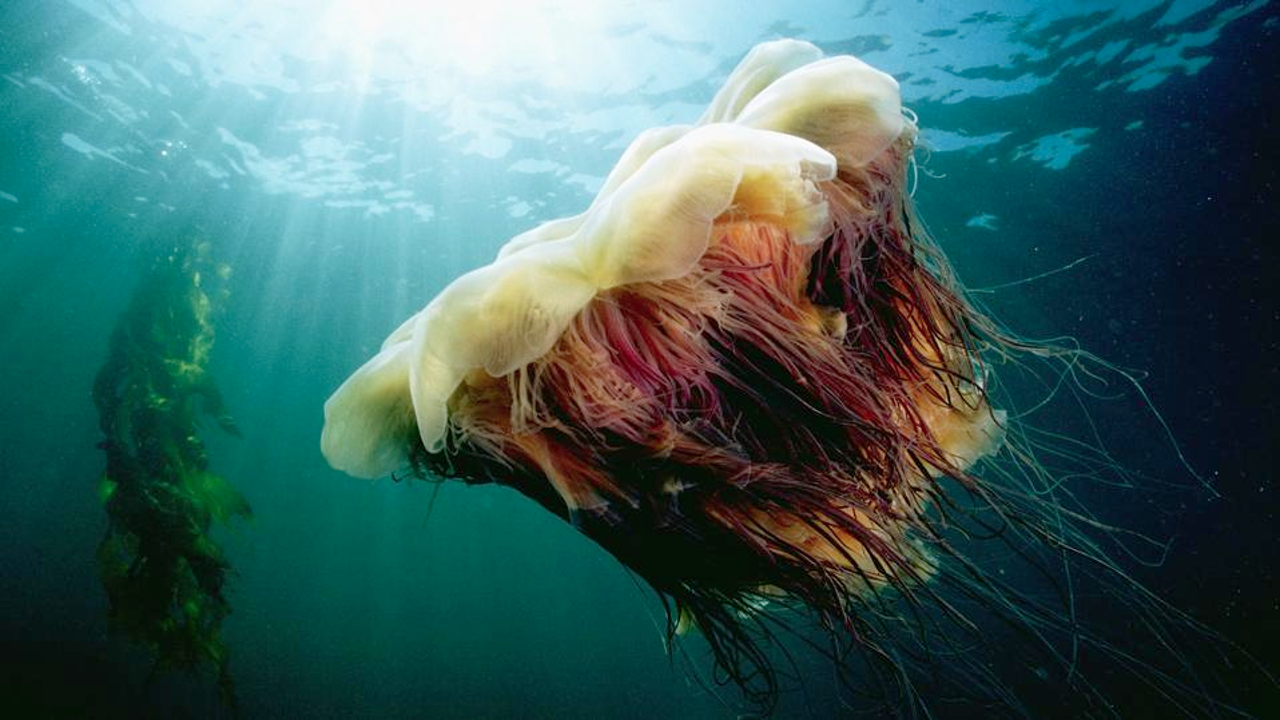
The longest animal on Earth, Cyanea capillata, has been named as the lion’s mane jellyfish, which measures 2.1 meters (7 feet) across and stretches 36.6 meters (120 feet) behind it, longer than any other animal on earth. The species was discovered in 1865 on a Massachusetts beach and still holds the record for longest length. The length of the lion's mane's tentacles is not coincidental as it is a passive hunter, relying heavily on ocean currents to travel distances. However, this has a mechanical cost, as research suggests that having extensive tentacles and oral arms can reduce a jellyfish’�s propulsion efficiency by up to 90% compared to a tentacle-free state. The lion‘s bell is divided into eight lobes, with each lobe containing roughly 70 to 150 tentacles arranged in four rows. In a large adult, these tentacles can number over 1,000 in total, each of which is lined with stinging cells known as nematocysts. Despite these adaptations, they also make it a significantly worse swimmer. The animal's structure allows it to grow to the larger size and is often used as a diagnostic tool for climate change.
Related Articles
Memorial, walk planned in honor of Monrovia bear euthanized by wildlife officials
A memorial and peace walk are planned for Blondie the mama bear euthanized by wildlife officials due to public safety concerns and previous attacks.
Physicists create electron 'catapult' that moves particles through solar material at record speed
A study reveals that molecular vibrations can rapidly transfer electrons in organic solar cells, potentially leading to more efficient and efficient conversion of sunlight into electricity.
The Longest Animal On Earth Has No Brain, No Bones And 1,200 Stingers — A Biologist Explains
The lion’s mane jellyfish, with massive tentacles and a stinging apparatus, is the longest animal on Earth and requires adaptation to survive in harsh Arctic waters.